
Tattoo removal
PicoLaser Tattoo Removal in Malta
Advanced Laser Tattoo Fading & Removal
Have a tattoo you no longer want?
Whether it is an old design, an unwanted name, a faded tattoo or a tattoo that no longer reflects your style, PicoLaser tattoo removal at DermaTec Med Aesthetic Clinic in Għaxaq, Malta, offers an advanced option for reducing unwanted tattoo ink.
Online offer available.See online offers
- Sessions
- About 6–12 or more
- Interval
- Around 6–8 weeks
- First step
- Free consultation
Our approach
Rediscover Clearer-Looking Skin with PicoLaser Technology
At DermaTec Med Aesthetic Clinic, we offer a personalised approach to tattoo removal, with treatment planning based on the tattoo's colour, size, age, ink depth, location and your skin type.
Our aim is to progressively fade the tattoo while taking care to minimise unnecessary injury to the surrounding skin.
About the treatment
What Is PicoLaser Tattoo Removal?
PicoLaser is an advanced laser technology that delivers energy in picoseconds – one trillionth of a second.
Traditional nanosecond lasers deliver pulses measured in billionths of a second, whereas picosecond systems use even shorter pulses. This allows the laser to create a strong photomechanical effect, helping to break tattoo pigment into smaller particles.
These fragmented particles are gradually processed and cleared by the body's immune system.
PicoLaser treatment can target selected tattoo colours, depending on the wavelengths used and the characteristics of the tattoo.
How it works
How Does PicoLaser Tattoo Removal Work?
Tattoo ink is deposited into the dermis, the deeper layer of the skin. Because the pigment is held within the skin, ordinary washing, exfoliation and topical creams cannot remove a permanent tattoo.
PicoLaser works through a controlled process:
01
Laser targeting
The appropriate laser wavelength is selected according to the tattoo pigment and skin characteristics.
02
Short energy pulses
The laser delivers extremely brief pulses of energy to the tattoo ink.
03
Pigment fragmentation
The energy breaks the ink into smaller particles through a photomechanical effect.
04
Natural clearance
The body's immune system gradually processes and removes some of the fragmented pigment.
05
Progressive fading
With a series of treatments, the tattoo may become progressively lighter.
Several sessions are normally required because the body needs time to clear fragmented pigment between treatments.
Tattoo colours
Which Tattoo Colours Can PicoLaser Treat?
Different tattoo colours absorb different laser wavelengths. The correct wavelength is therefore important for achieving an effective response. PicoLaser wavelengths may include:
- 1064 nm
- Commonly used for black and dark blue tattoo pigments and selected other colours.
- 532 nm
- Commonly used for red, orange and some yellow pigments.
- 755 nm
- Available on certain systems and used for selected blue and green pigments.
We will confirm which colours can be treated on our system at your consultation.
Tattoo colours and expected response
- Black
- Often responds well to suitable laser wavelengths.
- Dark blue
- Can respond well, depending on the pigment and laser system.
- Red
- May require a different wavelength from black ink.
- Green
- Can be more challenging and may require a dedicated wavelength.
- Yellow and orange
- Can be difficult to remove completely.
- White and flesh-coloured ink
- May respond unpredictably and can sometimes darken following laser exposure.
Multicoloured tattoos may require more than one wavelength and a different treatment strategy for each colour.
Tattoo types
What Types of Tattoos Can Be Treated?
PicoLaser may be suitable for a variety of unwanted tattoos, including:
- Professional tattoos.
- Amateur or homemade tattoos.
- Small decorative tattoos.
- Large multicoloured tattoos.
- Old or faded tattoos.
- Unwanted names, lettering and symbols.
- Selected cosmetic tattoos and permanent makeup.
Cosmetic tattoos, including eyebrow pigmentation, require particular caution because some pigments can darken or change colour after laser exposure. A test area may be recommended before proceeding.
Benefits
Benefits of PicoLaser Tattoo Removal
PicoLaser technology offers several potential advantages:
- Advanced short-pulse technologyDelivers laser energy in extremely brief pulses.
- Targets tattoo pigmentDesigned to fragment selected ink particles while limiting unnecessary treatment of surrounding skin.
- Suitable for selected coloursDifferent wavelengths can target different tattoo pigments.
- Progressive fadingThe tattoo can become lighter over a course of treatments.
- Treatment flexibilityThe treatment plan can be adapted to the tattoo's size, colour and response.
- No surgical removalThe procedure does not require cutting out the tattooed skin.
Complete removal is not guaranteed. Some tattoos may only fade partially, and residual pigment or changes in skin colour can remain.
Sessions
How Many PicoLaser Sessions Are Needed?
The number of sessions varies considerably from one person to another. As a general guide, a tattoo may require approximately6–12 or more sessions, although some tattoos need fewer treatments and others require considerably more.
The number of sessions depends on:
- Tattoo size and location.
- Ink colour and chemical composition.
- Depth and quantity of ink.
- Professional or amateur application.
- Age of the tattoo.
- Previous tattoo removal treatments.
- Individual skin characteristics.
- The body's ability to clear fragmented pigment.
Professional tattoos often contain denser and deeper ink than amateur tattoos, which can make them more difficult to remove.
An initial consultation is necessary to provide a realistic estimate.
Intervals
How Often Should Treatments Be Performed?
Tattoo removal requires time between sessions to allow the skin to recover and the body to clear fragmented pigment.
6–8 weeks
Treatment intervals are commonly around 6–8 weeks or longer, depending on the tattoo, treatment response and skin recovery.
Treating too frequently does not necessarily improve the final result and may increase the risk of unwanted skin reactions.
Your practitioner will recommend the appropriate interval following assessment.
Your appointment
What Happens During a PicoLaser Tattoo Removal Session?
01
Consultation and tattoo assessment
Before treatment, the practitioner will assess:
- Tattoo size and location.
- Ink colours and density.
- Tattoo age.
- Skin type and pigmentation.
- Previous treatments or scarring.
- Medical history and relevant contraindications.
The expected results, possible risks and estimated number of sessions will be discussed. Photographs may be taken to monitor progress.
02
Preparation
The treatment area is cleaned and prepared. Appropriate protective eyewear must be worn by the client and treatment personnel.
A test spot may be recommended, particularly for unusual pigments, cosmetic tattoos or individuals with an increased risk of pigmentary changes.
03
Laser treatment
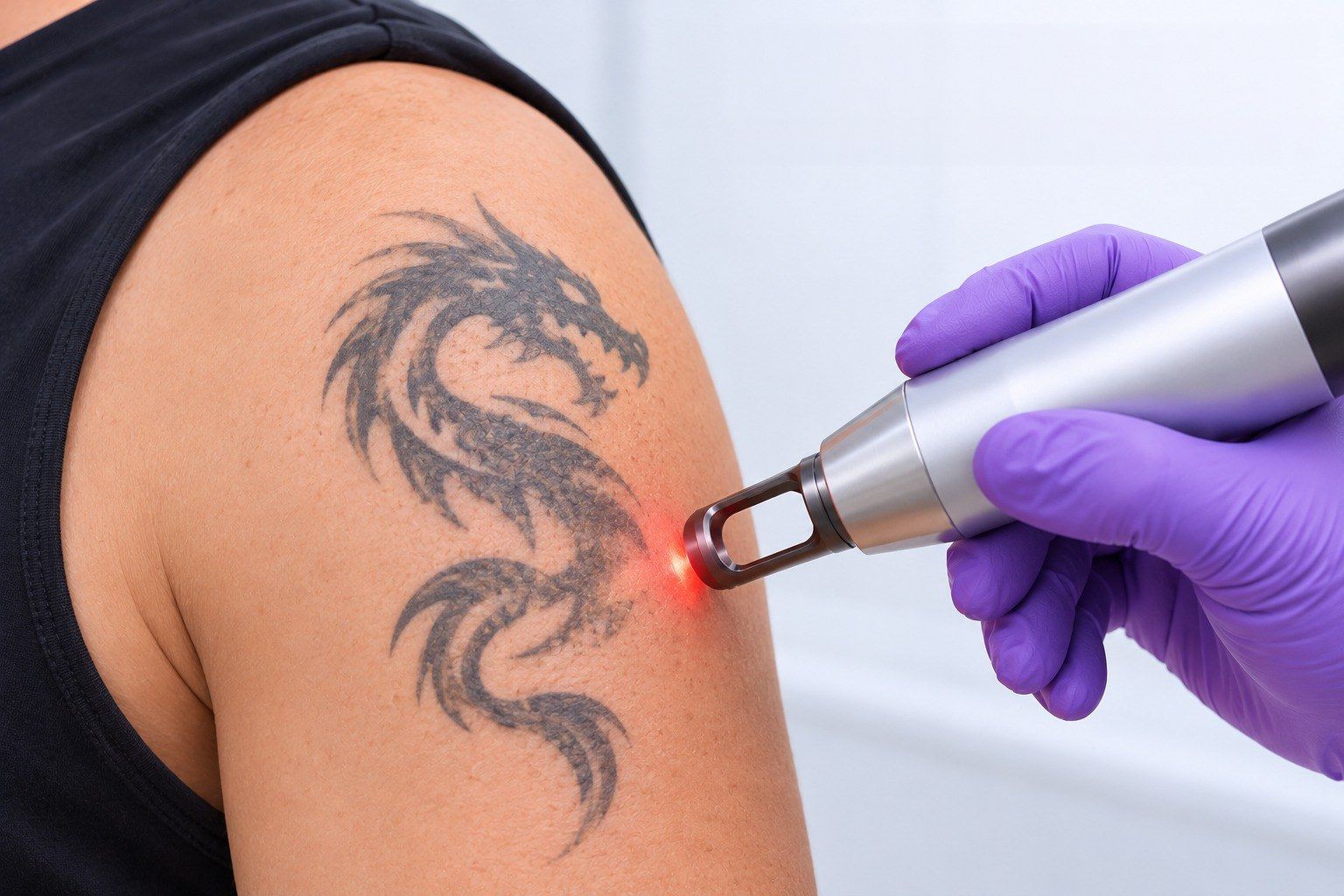
The PicoLaser handpiece is directed at the tattooed area, delivering controlled pulses to the selected pigment.
The client may experience a snapping or stinging sensation, often compared to a small elastic band flicking against the skin. Treatment time depends on the size, colour and complexity of the tattoo.
04
After treatment
Temporary redness, swelling, tenderness and small pinpoint bleeding may occur. Some tattoos may develop superficial blistering or crusting during the healing process.
The treated area must be kept clean and protected while it heals.
Comfort
Is PicoLaser Tattoo Removal Painful?
The sensation varies according to the tattoo's location, size, ink density and individual pain tolerance.
Many people describe the sensation as similar to repeated elastic-band snaps against the skin. Some areas of the body are more sensitive than others. Appropriate cooling or other pain-management measures may be considered by the practitioner.
Please note that the treatment is not completely painless.
Recovery
Recovery and Aftercare
Following PicoLaser tattoo removal, the treated area may appear red, swollen or sensitive. Correct aftercare helps support healing and reduce the risk of complications.
Recommended aftercare
- Keep the treated area clean and follow the practitioner's dressing instructions.
- Avoid picking, scratching or removing any crusts or blisters.
- Do not deliberately expose the treated area to sunlight.
- Use appropriate sun protection once the skin has healed, as advised.
- Avoid swimming pools, saunas and activities that may irritate the area until the skin has recovered.
- Avoid applying irritating products, perfumes or exfoliating treatments to the treated area.
- Do not apply unprescribed creams or home remedies.
- Contact the clinic if you notice increasing pain, spreading redness, pus, fever or other signs of infection.
Healing time varies according to the treatment response and individual skin characteristics.
Safety
Possible Side Effects and Risks
PicoLaser tattoo removal is a medical-aesthetic procedure and is not completely risk-free.
Possible side effects include:
- Temporary redness and swelling.
- Tenderness or discomfort.
- Pinpoint bleeding.
- Blistering or crust formation.
- Temporary darkening or lightening of the skin.
- Post-inflammatory hyperpigmentation.
- Hypopigmentation (loss of skin colour).
- Infection.
- Scarring.
- Changes in skin texture.
- Incomplete tattoo removal.
- Unexpected changes in tattoo pigment colour.
The risk of complications can be influenced by skin type, tattoo pigment, laser wavelength, treatment parameters and aftercare.
A qualified and appropriately trained practitioner should assess the suitability of treatment and explain the risks before proceeding.
Who it suits
Who Is Suitable for PicoLaser Tattoo Removal?
PicoLaser may be suitable for adults who wish to lighten or remove an unwanted tattoo and whose skin and medical history are appropriate for treatment.
A consultation is required before treatment.
Postponing treatment
When Treatment May Need to Wait
Treatment may need to be postponed or avoided in certain circumstances, including:
- Active skin infection or inflammation in the treatment area.
- Open wounds or incomplete healing.
- Recent tanning or sunburn.
- Certain skin conditions affecting the treatment area.
- A history of abnormal scarring or keloids.
- Pregnancy, where treatment is generally deferred as a precaution.
- Certain medications or medical conditions that may affect healing or photosensitivity.
Suspicious, changing or undiagnosed skin lesions within a tattoo should be medically assessed before any laser treatment.
Realistic expectations
Can PicoLaser Completely Remove a Tattoo?
Complete tattoo removal is not always possible.
Some tattoos respond very well and may become barely visible, while others retain traces of pigment even after multiple sessions.
The final result depends on the ink composition, colour, depth, density, tattoo age, skin type and individual immune response.
Our priority is to provide an honest assessment and a realistic treatment plan rather than promise a guaranteed outcome.
Scarring
Can PicoLaser Remove a Tattoo Without Leaving a Scar?
PicoLaser is designed to target tattoo pigment while limiting unnecessary damage to surrounding tissue. However, no laser tattoo removal treatment can guarantee scar-free results.
Scarring may occur, particularly where the original tattoo has already caused scarring, the skin develops complications during healing or the treatment is unsuitable or incorrectly performed.
Careful assessment, appropriate treatment selection and correct aftercare are important.
Questions
Frequently Asked Questions
Can old tattoos be removed with PicoLaser?
Yes. Old tattoos can often be treated, although the response depends on the pigment, depth, colour and other tattoo characteristics. Older tattoos may sometimes be easier to fade, but this is not guaranteed.
Can professional tattoos be removed?
Yes. Professional tattoos can be treated, although they may require more sessions because they often contain greater quantities of ink deposited at a consistent depth.
Can coloured tattoos be removed?
Selected coloured tattoos can be treated using appropriate wavelengths. Some colours, particularly green, yellow, orange and certain cosmetic pigments, may be more difficult to remove completely.
How long does each session take?
Treatment time depends on the size and complexity of the tattoo. A small tattoo may take only a few minutes, while a larger or multicoloured tattoo will take longer.
Can I remove only part of a tattoo?
In selected cases, a specific section of a tattoo can be targeted. This should be discussed during consultation because treating only part of a design may leave an uneven appearance.
Can PicoLaser remove permanent eyebrow makeup?
Some cosmetic eyebrow pigments can be treated, but they require particular caution. Certain pigments may darken or change colour after laser exposure. Assessment and a test spot may be necessary.
When will I see results?
Some fading may become noticeable after the first treatment, but improvement is gradual. The body continues clearing fragmented pigment over the weeks following each session.
Can I have another tattoo over the treated area?
A new tattoo may be considered once the treated skin has completely healed and the removal process has reached a suitable stage. Timing should be discussed with your practitioner and tattoo artist.
At the clinic
Why Choose DermaTec Med Aesthetic Clinic?
At DermaTec Med Aesthetic Clinic, we believe tattoo removal should begin with careful assessment, realistic expectations and an individual treatment plan.
We take into consideration the tattoo's characteristics, your skin type and your desired result before recommending treatment.
Our focus is on a professional approach, appropriate laser selection, skin safety and clear aftercare guidance.
Book Your PicoLaser Tattoo Removal Consultation
Considering removing an unwanted tattoo?
Contact DermaTec Med Aesthetic Clinic to arrange a consultation and find out whether PicoLaser tattoo removal may be suitable for you.